
List of Sources:
- Young et al., 20201
- Image generated by WordPress AI
Table of Contents:
- Gravitational Potential Energy (Young et al., 2020)
- Elastic Potential Energy (Young et al., 2020)
- Conservative and Nonconservative Forces (Young et al., 2020)
- Force and Potential Energy (Young et al., 2020)
- Energy Diagrams (Young et al., 2020)
Gravitational Potential Energy (Young et al., 2020)
Energy that is associated with the position of an object is called potential energy. For instance, a bird sitting on a cliff stores potential energy, which can then be converted to kinetic energy as the bird dives and accelerates towards the ground. The word ‘potential’ refers to the potential of work that could be done on an object. When that work is done by gravity, it is called gravitational potential energy, a potential energy related to the object’s weight and height (position) above the ground.
Expression for Gravitational Potential Energy
Consider an object of mass m moving vertically along the y-axis (downwards). Initially, the object is at y1 and at a later time, it is at y2.
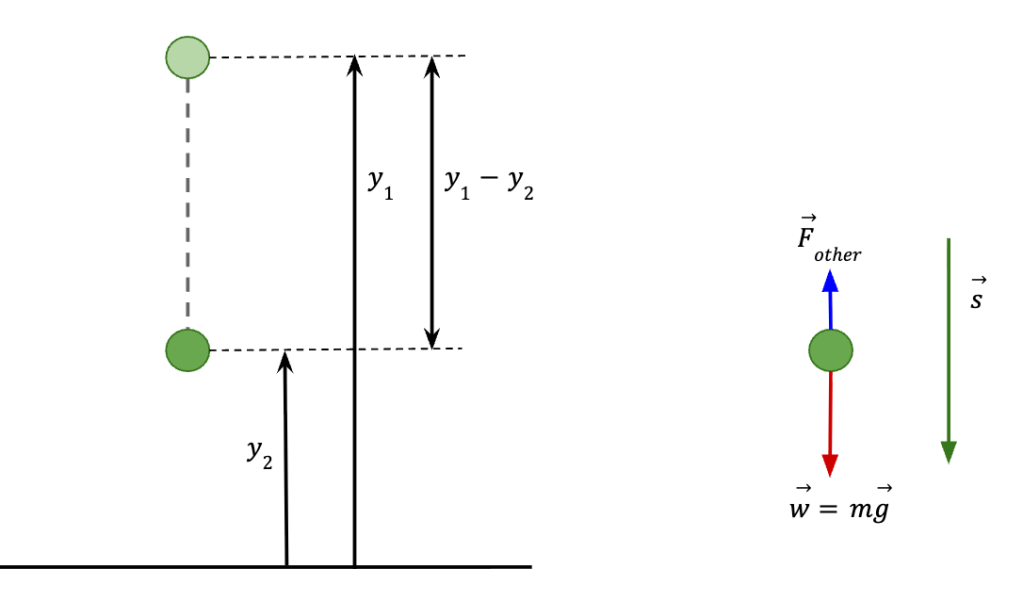
The ball is acted upon by gravitational force which is given by its weight2 (w=mg) and other resistive forces (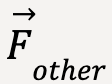 ) such as air drag. Since the weight of the object is in the same direction as the displacement, work done by gravity will be positive.
Wgrav = Fscos0° = w (y1-y2) = mgy1 – mgy2 …..(1)
If let’s say the object is moving upwards instead, such that y2 is larger than y1, then work done by gravity, Wgrav, will be negative as it should be since weight is acting in a direction opposite to the object’s displacement.
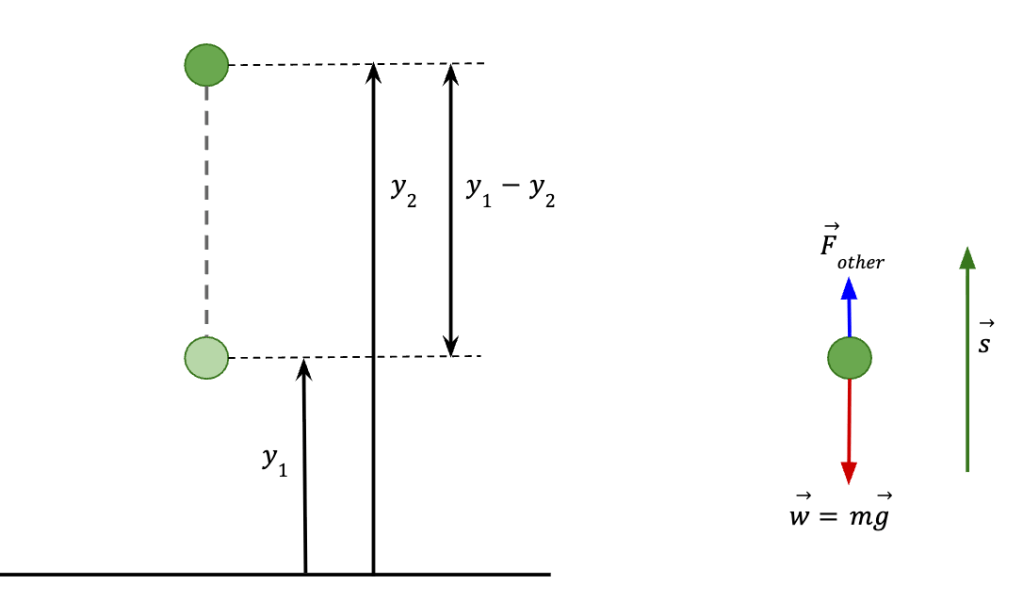
The quantity mgy is defined as gravitational potential energy, Ugrav;
Ugrav = mgy…..(2)
where m is the mass of the object, g is the acceleration due to gravity (=9.80m/s2) and y is the object’s height above the ground (or it’s y-coordinate). The SI unit of potential energy is joule (J).
This means that for an object moving vertically, the initial gravitational potential energy is given by Ugrav,1 = mgy1 and the final gravitational potential energy is equal to Ugrav,2 = mgy23.
Thus, the change in gravitational potential energy is equal to;
 …..(3)
Equation (1) can then be rewritten as;
 …..(4)
Therefore, work done by gravity is equal to the negative of the change in the gravitational potential energy.
Importance of the Negative Sign
Work done by gravity is equal to the negative of change in gravitational potential energy.
This means that when an object goes upwards, work done by gravity is negative (weight acting in opposite direction to the object’s displacement), and it’s height above the ground (y) increases and so does the gravitational potential energy . Thus, the change in gravitational potential energy is positive (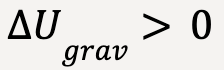 ).
).
Conversely, when an object moves downwards, work done by gravity is positive because weight acts in the same direction as the displacement. In this case, object’s height above ground and the gravitational potential energy decrease. This means that the change in gravitational potential energy is negative (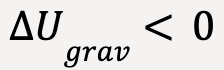 ).
).
Conservation of Total Mechanical Energy (Gravitational Forces Only)
Consider a situation where the only force acting on an object is it’s weight and 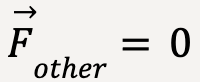 . It is moving vertically up or down, such that at y1, it has a speed of v1 and at y2, it has a speed of v2. According to work-energy theorem,
 …..(5)
Since gravity is the only force doing work on the object, using equation (4);
 …..(6)
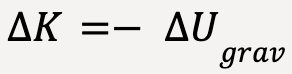
Comparing equations (5) and (6), we get;
 …..(7)
or
 …..(8)
Rearranging equation (8);
 …..(9)
Thus, when an object is solely under the influence of gravitational force, the total mechanical energy (the sum of kinetic and potential energies) of the system4 is conserved. The total mechanical energy is generally denoted by the letter E.
At y1, E1 = K1 + Ugrav,1 and at y2, E2 = K2 + Ugrav,2. As per conservation of total mechanical energy;
E1 = E2 = E = constant …..(10)
which means that at every point y above the ground5, E has the same value, given that gravity is the only force that does work on the object6.
For example, a cannonball shot at an angle follows a projectile trajectory. If the effects of air are negligible, the only force acting on it is the force of gravity. This would mean that at every point along its motion, the total mechanical energy (E) will be conserved (see Figure 3).
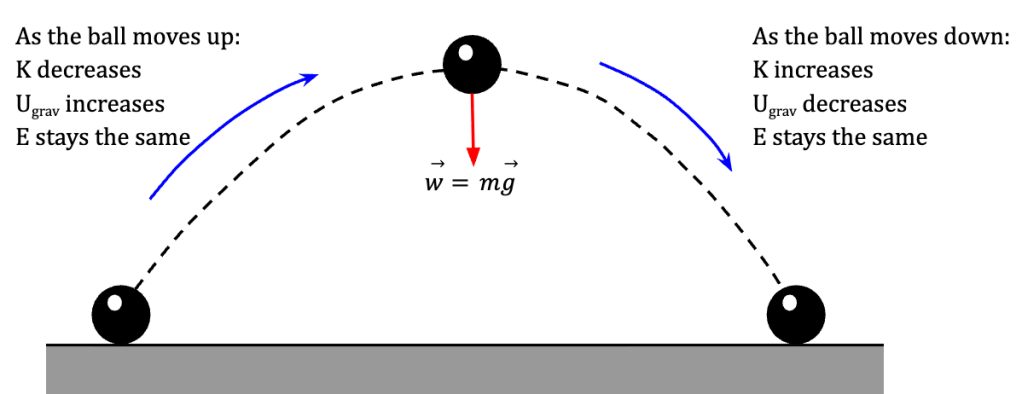
As the ball moves upwards, it’s speed starts to decrease while it’s height above ground increases. This leads to a decrease in it’s kinetic energy (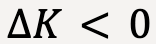 ) with an equal amount of increase in the gravitational potential energy (), resulting in total mechanical energy (E) staying the same.
When the ball starts to descend, it’s speed increases while it’s height above ground decreases. This in turn leads to an increase in it’s kinetic energy (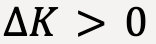 ) with an equal amount of decrease in the gravitational potential energy (), resulting in total mechanical energy (E) staying the same.
When Forces Other Than Gravity Do Work
Consider a scenario, where in addition to gravity, other forces also act on the object such that 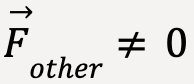 . In this case, the total work done is given by;
 …..(11)
The total work done is equal to the change in object’s kinetic energy;
 …..(12)
Substituting the expression for Wgrav as given by equation (6);
 …..(13)
Rearranging;
 …..(14)
where K1 = 1/2mv12, K2 = 1/2mv22 , Ugrav,1 = mgy1 and Ugrav,2 = mgy2.
This means that the work done by forces other than gravity is equal to the change in total mechanical energy of the system.
If Wother is positive, the total mechanical energy of the system increases and if Wother is negative, the total mechanical energy of the system decreases. Finally, if Wother = 0, the total mechanical energy of the system stays constant.
Gravitational Potential Energy for Motion Along a Curved Path
Consider a particle that travels along a curved path. It is acted on by the gravitational force given by it’s weight, 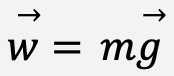 and other forces,
 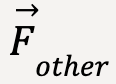 .
.
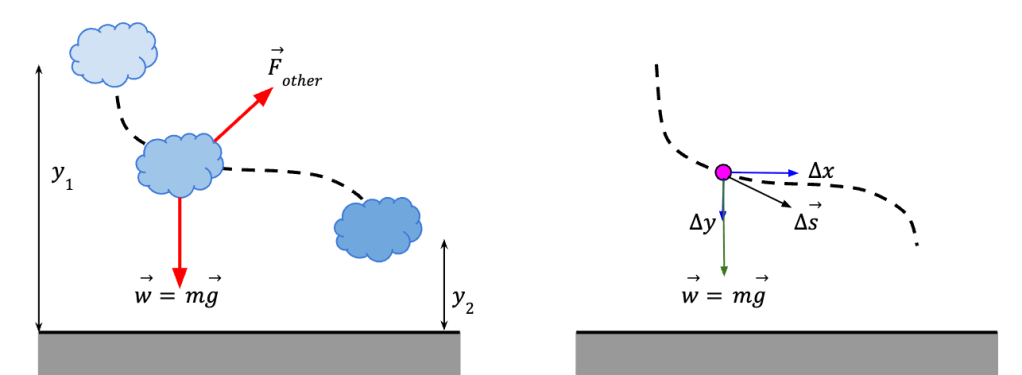
 is broken down into it’s x and y components. Gravity does work only along the vertical component of displacement given by
  (right).
Now, break the particle’s path into small displacements given by . Work done by gravity along this small displacement can be calculated by taking a scalar product of force, in this case particle’s weight, and displacement vector (taking upwards direction as positive y);
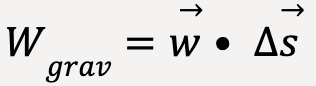 …..(15)
 …..(16)
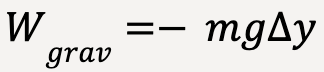 …..(17)
This means that work done by gravity is not affected by the horizontal displacement  , and is equivalent to work that would have been done had the cloud moved vertically downwards by a distance .
Since this can be said for each small displacement along the particle’s curved path, the total work done by gravity is;
 …..(18)
Thus, work done by gravity only depends on the mass (m), acceleration due to gravity (g) and the particle’s vertical displacement (y2-y1) regardless of whether the path is curved or straight7. If gravity is the only force acting on the particle, then the total mechanical energy is still conserved.
Elastic Potential Energy (Young et al., 2020)
Consider a rubber band that is stretched using external force. Just like gravitational potential energy, energy is stored in this stretched rubber band, which when released is converted into kinetic energy8. When energy is stored in an object that can change its shape, such as a spring or rubber band, it is referred to as elastic potential energy. An object is said to be elastic if it has the ability to return to it’s original form (shape and size) after undergoing deformation (such as stretching or compressing).
The Case of an Ideal Spring
An ideal spring obeys Hooke’s law, which provides a relationship between the amount of force,  required to stretch or compress a spring by a displacement x. This relationship is given by; F=kx where k is the spring constant9.
Consider an ideal spring (as seen in figure 5) that has it’s left end attached to a wall (in other words, it is kept stationary) while it’s right end is attached to a block of mass m and is free to move along the x-axis. Initially, the spring is in it’s rest position (x=0) such that it is neither stretched nor compressed.
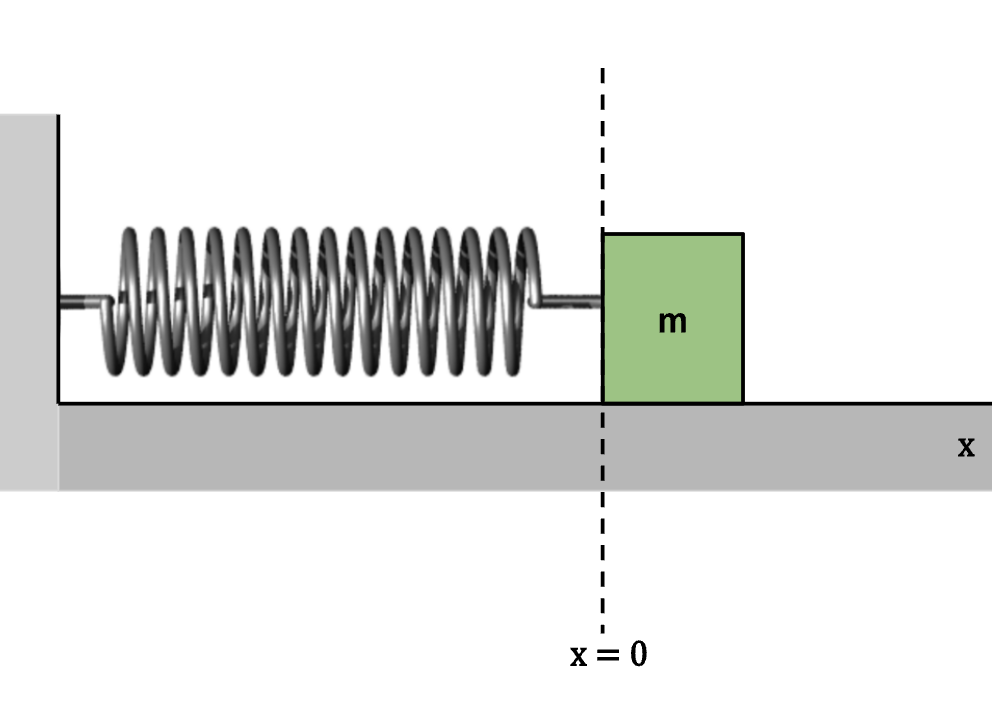
The block is then pulled and released such that the spring is stretched before it restores to it’s original form (see figures 6 and 7). This means that both x1 and x2 are positive and the block moves along the positive x-direction.
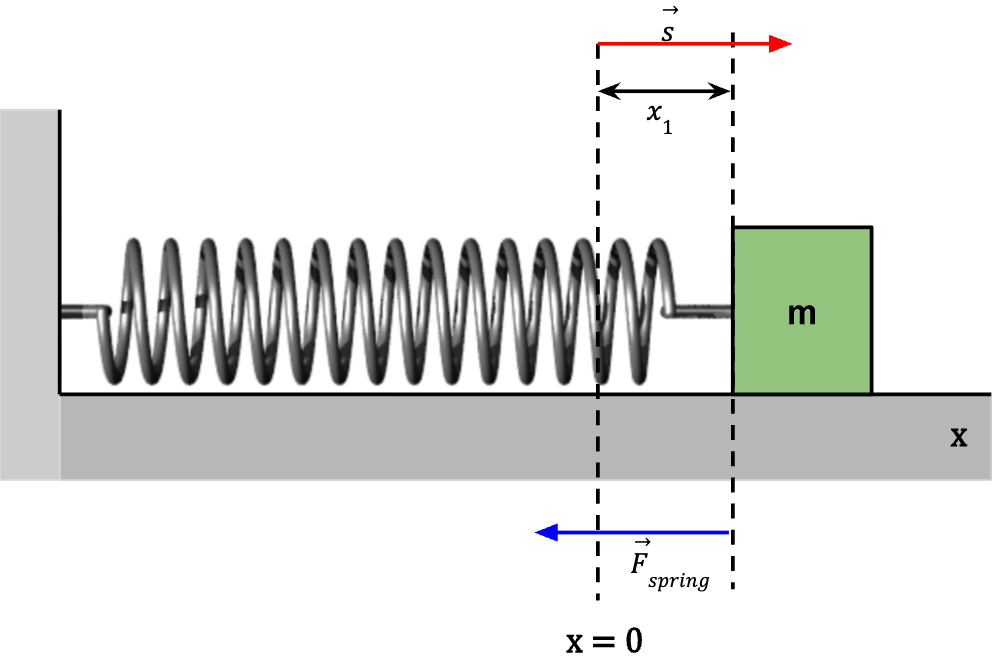
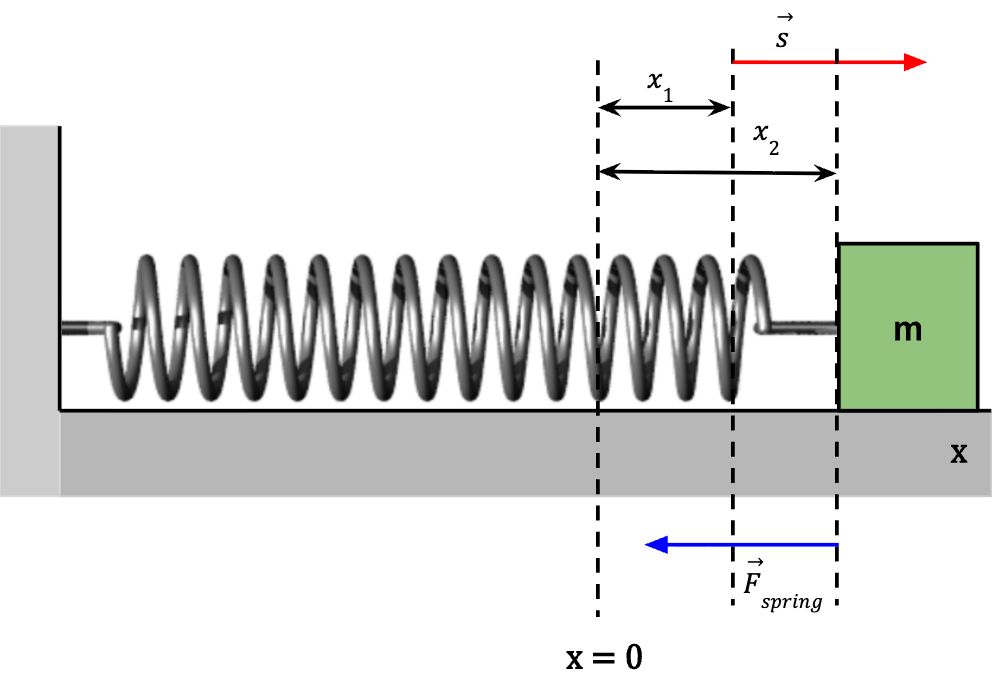
The work done by the external force, to move the spring from location x1 to location x2 is given by (as discussed before);
 …..(19)
Note: W is work that is done on the spring.
When external force stretches the spring by pulling on one end, it does positive work on the block and in turn on the spring (force in same direction as displacement). In equation (19), x2 > x1 and W is positive. However, when you stop pulling but are still holding the block, the spring starts to relax and you do negative work on the block and the spring (force in opposite direction to the displacement). In equation (19), x2 < x1 and W is negative (see figure 8).
When the spring is compressed by external force (both x1 and x2 are negative), the force does positive work on the block and in turn positive work on the spring. In equation (19), x22 is larger than x12 and W is positive. However, when external force stops pushing but still holds onto the block, the spring starts to relax and the external force does negative work on the block and on the spring. In equation (19), x22 is less than x12 and W is negative (see figure 8).
According to Newton’s third law, spring does work which is simply negative of the work done on the spring.
Wby spring = -Won spring …..(20)
Using equation (19), work done by the spring is then given by;
 …..(21)
where el stands for elastic.
When the spring is stretched (both x1 and x2 are positive), work done by the spring on the block is negative. In equation (21), x2 > x1, Wel is negative and the block slows down. However, as the spring starts to relax, it does positive work on the block. In equation (21), x2 < x1, Wel is positive and the block speeds up (see figure 8).
When the spring is compressed (both x1 and x2 are negative), work done by the spring on the block is negative. In equation (21), x22 > x12, Wel is negative and the block slows down. However, as the spring starts to relax, it does positive work on the block. In equation (21), x22 < x12, Wel is positive and the block speeds up (see figure 8).
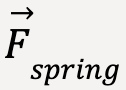
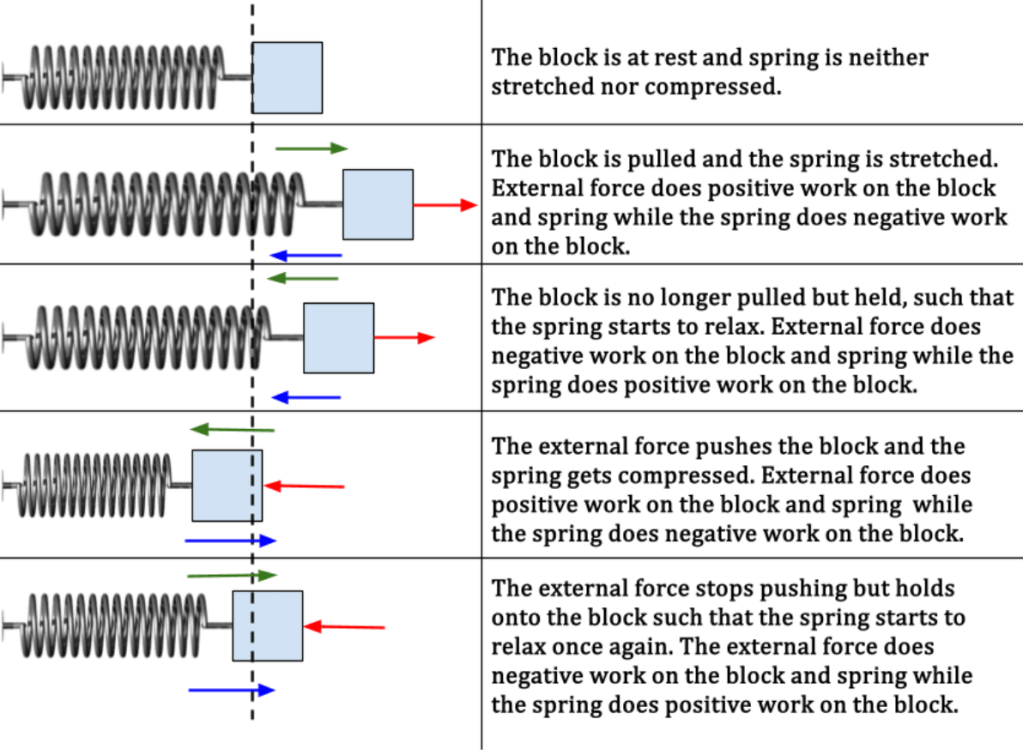 ; the blue arrows represent the force exerted by the spring,
  ; and the green arrows represent the displacement vector,
  . Positive work is done when the force is in the same direction as the displacement vector and negative work is done when force and displacement are in the opposite direction.
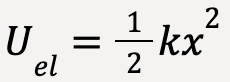
We can then define elastic potential energy (Uel)as;
 …..(22)
where k is the spring constant and x is the elongation of the spring10. It’s SI unit is the joule (J)11.
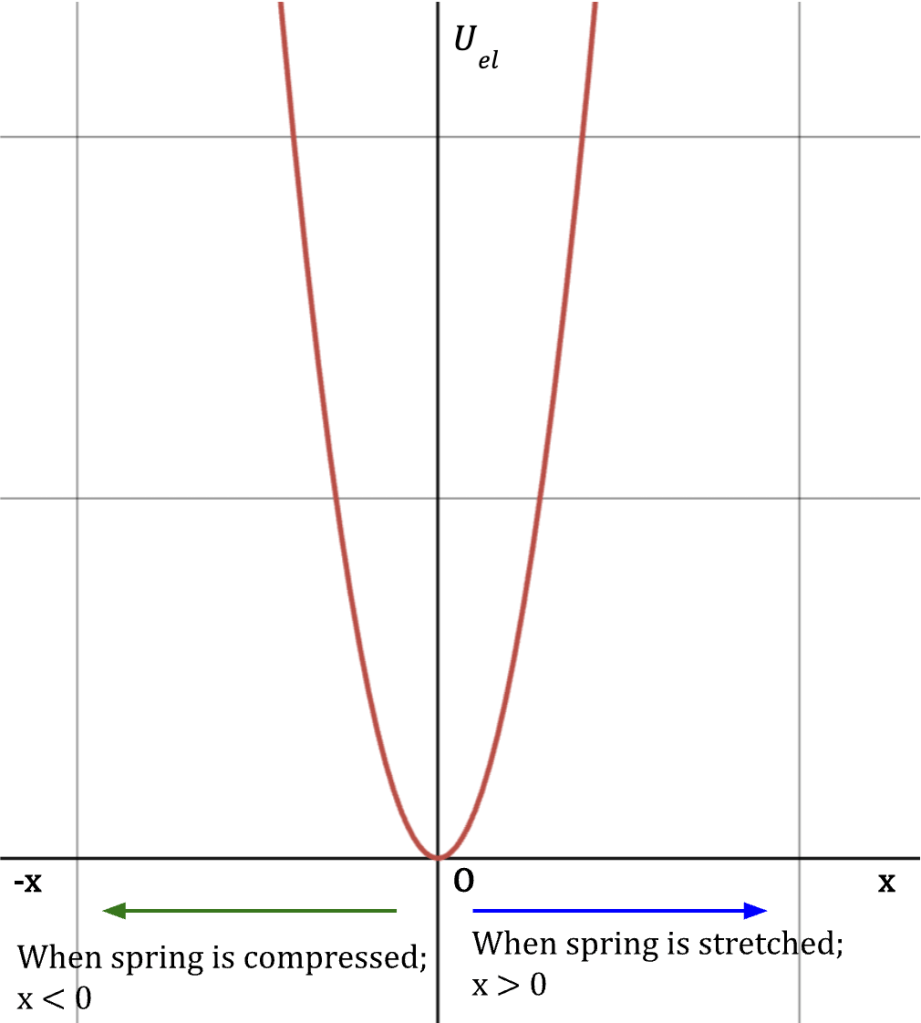
Graphically;
We can now rewrite equation (21) as;
 …..(23)
This means that when an already stretched spring is stretched a bit further, work done by the spring is negative (as seen in figure 7). However, change in elastic potential energy is positive because as x increases, Uel increases and more elastic potential energy is stored in the spring. Conversely, when a stretched spring starts to relax, work done by the spring is positive (see figure 8). However, as x decreases, Uel decreases and the spring starts to lose elastic potential energy. This results in a negative value for the change in spring’s elastic potential energy. This can be verified by looking at the graph in figure 9. The more an ideal spring is stretched or compressed, larger is the amount of elastic potential energy stored in it.
Now according to work-energy theorem,
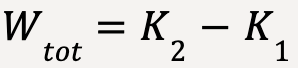 …..(24)
If elastic force is the only force acting on an object;
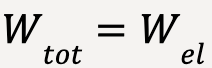 …..(25)
Combining equation (24) and (25), we get;
 …..(26)12
Thus, total mechanical energy (E) is conserved;
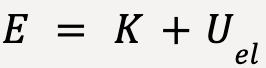 …..(27)
In this case, total mechanical energy is equal to kinetic energy and elastic potential energy.
Situations with both Gravitational and Elastic Potential Energy
Consider a situation where you have an object that is being acted on by gravity, elastic force and other forces such as air resistance. An example would be a block hanging vertically from the end of a spring and moving against air resistance. In this case, the total work done is equal to the sum of work done by gravity, elastic force and other forces;
 …..(28)
According to work-energy theorem;
 …..(29)
Utilizing equations (4) and (23), we can rewrite equation (29) as;
 …..(30)
or more generally as;
 …..(31)
where U is the sum of gravitational potential energy and elastic potential energy.
Thus, work done by forces other than gravity and elastic force is equal to the change in the total mechanical energy of the system13 which is given by E = K + U.
Once again, the mechanical energy of the system increases if Wother is positive, decreases if Wother is negative and is conserved if Wother equals zero.
An Example: Consider a child jumping on a trampoline (ignore air resistance and friction in the trampoline14).
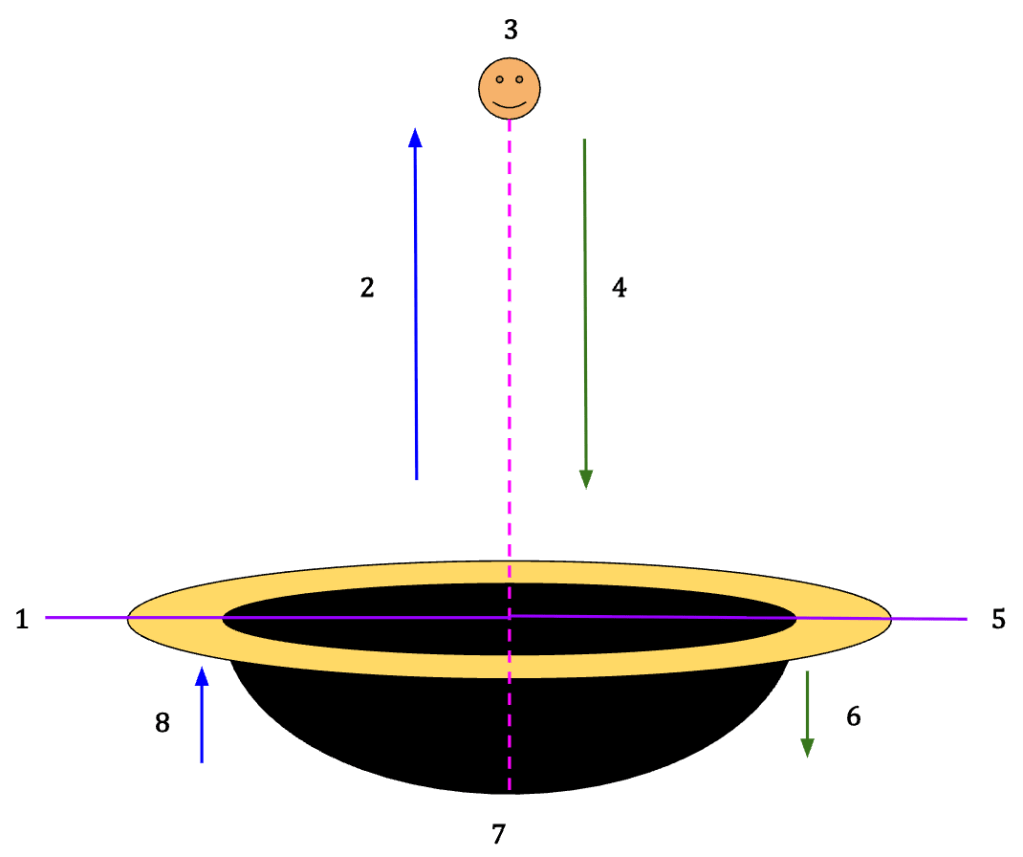
- The child lifts himself up to get on the trampoline (increase in Ugrav) and then bends his knees to propel himself upwards (increase in K) and leaves the trampoline with a certain kinetic and potential energy.
- As the child moves upwards, his kinetic energy starts to decrease while the potential energy increases.
- At the highest point, K=0 while Ugrav is maximum.
- As the child starts to descend, his kinetic energy starts to increase while potential energy decreases.
- As the child touches the surface of the trampoline, some of the total mechanical energy gets converted into elastic potential energy.
- As the child descends further while in contact with the trampoline, K starts to decrease, Ugrav further decreases while Uel starts to increase.
- At the lowest point, K=0 (child comes to a momentary stop), Ugrav is minimum and Uel is maximum (trampoline is stretched to its maximum).
- Finally, as the child starts to move upwards once again while in contact with the trampoline, K starts to increase (up until the point he leaves the trampoline), Ugrav starts to increase and Uel starts to decrease (it becomes zero just as the child leaves the trampoline).
Conservative and Nonconservative Forces (Young et al., 2020)
Conservative Forces
When work done by a force is reversible such that kinetic and potential energies can convert back and forth into one another without any loss to the total mechanical energy of the system, the force is referred to as a conservative force.
For example, when a ball is thrown upwards in the absence of air resistance, kinetic energy is converted into potential energy on it’s way up and potential energy is converted back into kinetic energy on the way down. The ball returns to the initial position with same velocity meaning the total mechanical energy of the system remains conserved.
Some examples of conservative forces include gravitational force, spring force and electric force.
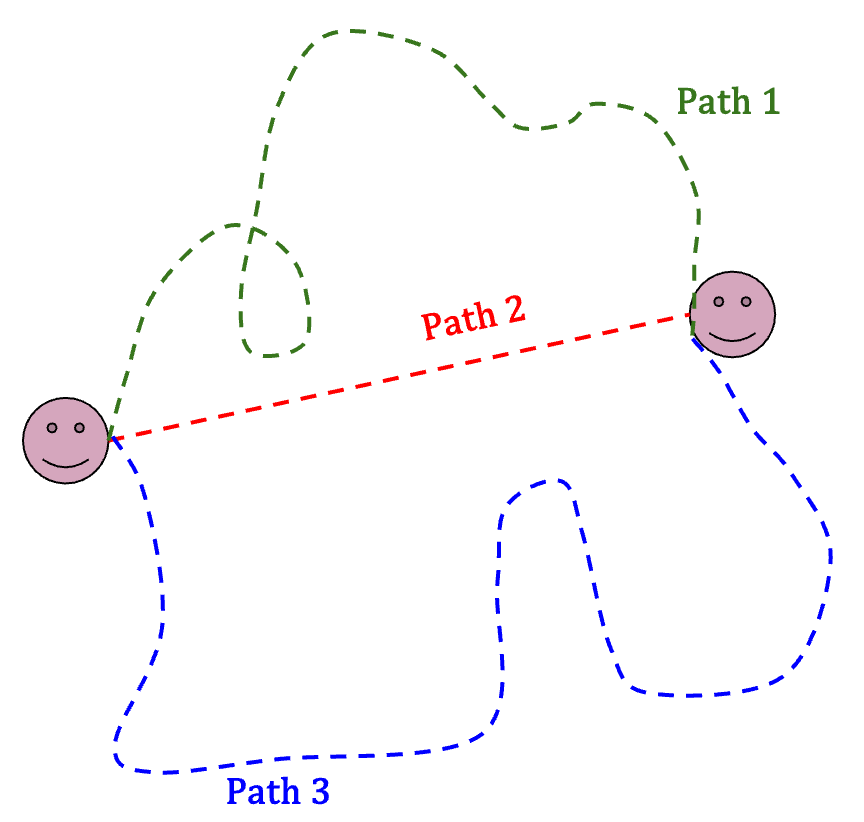
Work done by conservative forces does not depend on the path taken by the object. In other words, it only depends on the initial and final point. Thus work done by a conservative force can be expressed as a “difference between the initial and final values of a potential-energy function”. This means that if the particle travels in a closed loop such that the initial and the final point is the same, the total work done by the force is always zero.
Nonconservative Forces
When work done by a force is not conserved, the force is referred to as a nonconservative force. As such, work done by a nonconservative force cannot be described by a potential-energy function.
Some examples of nonconservative forces include the friction force and fluid resistance. For instance, consider a ball thrown upwards in the presence of air resistance. Air resistance does negative work when the ball travels upwards and when the ball is descending. This leads to a loss in the total mechanical energy of the system that can never be recovered. The ball lands at the initial point with decreased velocity and reduced kinetic energy. Thus, the work done by nonconservative forces is irreversible (ball does not recover the initial kinetic energy when it’s motion is reversed).
Friction force and fluid resistance are also referred to as dissipative forces because the total mechanical energy of the system is reduced due to losses in the form of heat, etc. There are nonconservative forces that add energy to the system such that the total mechanical energy of the system increases.
The Law of Conservation of Energy
Even though nonconservative forces cannot be expressed as potential-energy functions, they can be described using the concept of internal energy.
When a block sliding on a rough surface comes to a halt due to friction, block’s exterior and the surface become hotter. This energy that represents a “change in the state of the material” is referred to as the object’s internal energy. A rise in the object’s temperature leads to an increase in internal energy, while lowering an object’s temperature is associated with a decrease in it’s internal energy.
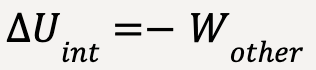
Experimentally, it has been shown that the magnitude of work done by friction is equal to the amount of increase in the internal energy of the system. However, work done by friction is negative but change in the internal energy of the system (increase in temperature) is positive. This can be expressed as;
 …..(32)
where 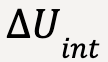 is the change in the internal energy of the system and Wother is the work done by forces other than gravity and elastic force.
Substituting equation (32) into equation (31), we get;
 …..(33)
or
 …..(34)
where  = K2-K1 and
  = U2-U1.
Equation (34) gives us the general form of the law of conservation of energy. This law states that energy can never be created or destroyed but it can change from one form to another. That is a universal fact with no exceptions yet found. In case of a book sliding on the rough surface, a decrease in kinetic energy is made up by an increase in the internal energy of the system.
Force and Potential Energy (Young et al., 2020)
If the potential-energy function is known, the corresponding force can be determined using calculus.
Force and Potential Energy in One Dimension
Consider a particle moving in a straight line along the x-axis, such that a force, is acting on it. For our purposes, we only need to look at the x-component of the given force, Fx(x). The notation Fx(x) means that the force is a function of x, and is the x-component of the given force, . The corresponding potential-energy function is then given as U(x). The notation U(x) means that the potential energy is also a function of x.
As discussed earlier, work done by a conservative force is equal to the negative of the change in the potential energy;
 …..(35)
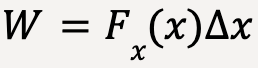
Now break the total displacement undertaken by the particle into infinitesimal increments given by  . Over each , we can approximate that the force, Fx(x) is constant. If the force is constant, work is simply given by;
 …..(36)
Combining equations (35) and (36), we get;
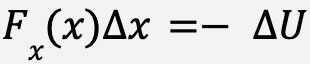 …..(37)
or
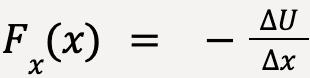 …..(38)
Now, in the limit that goes to zero, we can say;
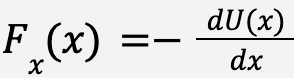 …..(39)
Thus, the value of a conservative force at point x is simply the negative derivative of the potential-energy function with respect to x.
In regions where there is a rapid change in the potential-energy function with respect to x, dU(x)/dx is large and so is the force. The negative sign in equation (39) means that when Fx(x) is acting in the positive x-direction, the potential-energy function, U(x), decreases as x increases. In other words, if we plot U(x) with respect to x, Fx(x) is the negative of the slope of the tangent at any instant. If Fx(x) is positive, slope dU(x)/dx is negative and U(x) is decreasing with increasing x.
Physically, equation (39) means that “a conservative force always acts to push the system toward lower potential energy“.
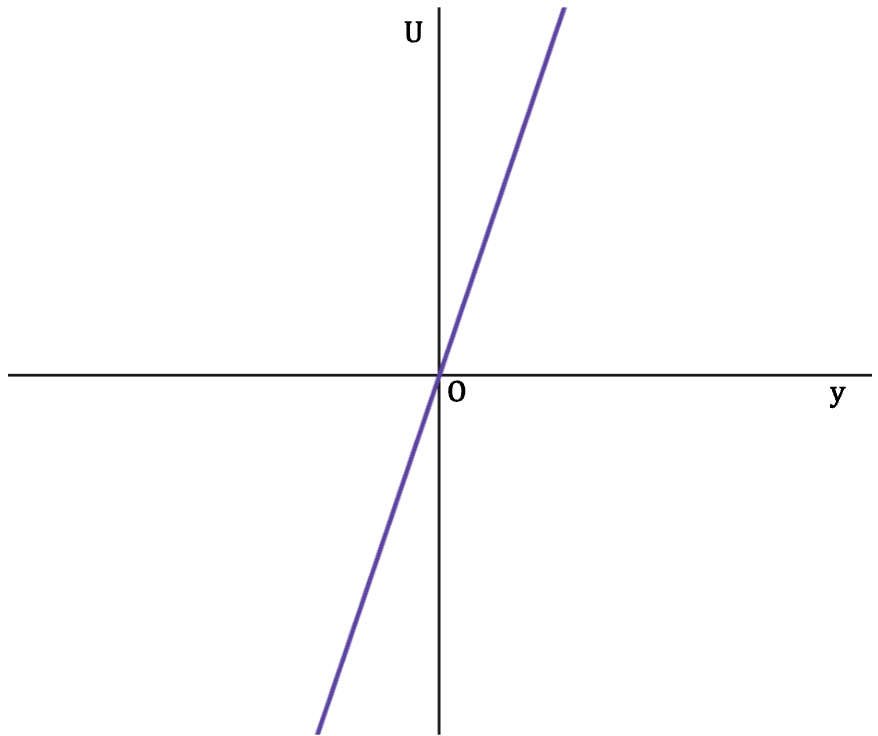
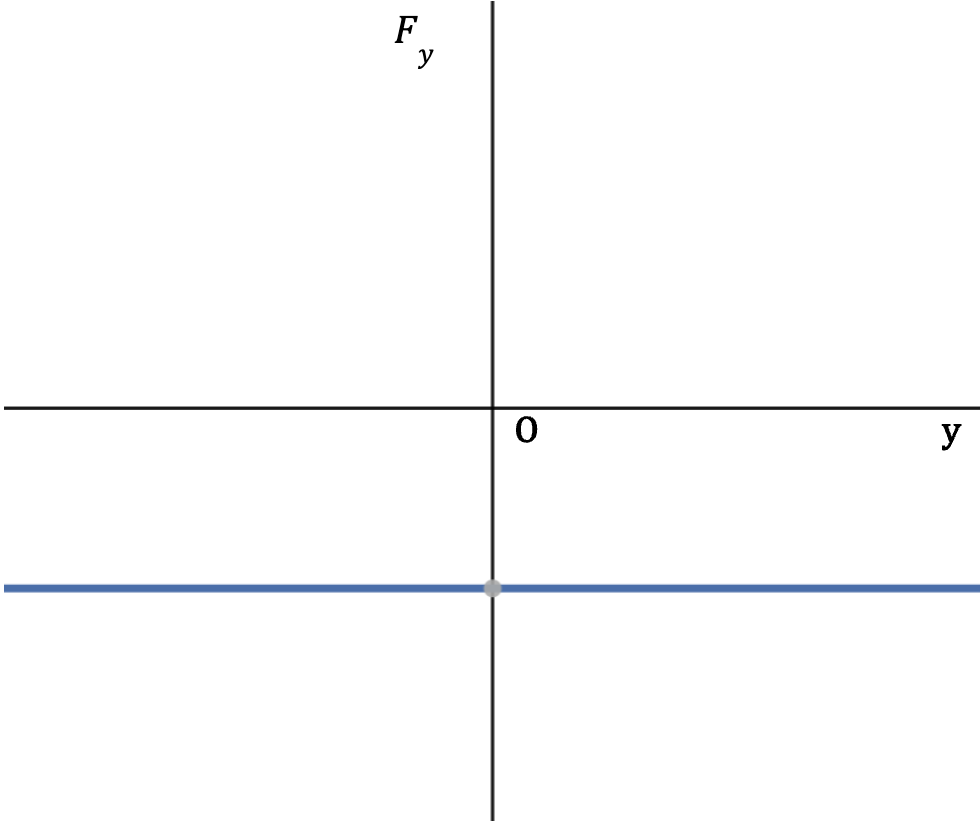
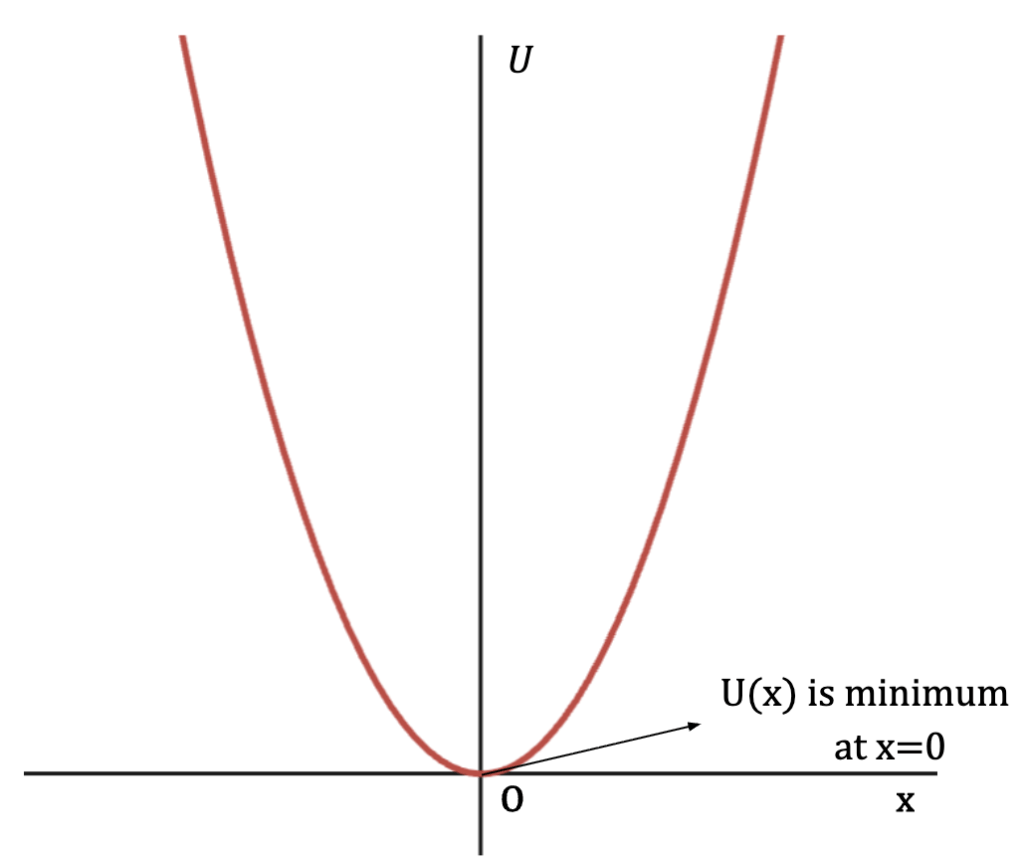
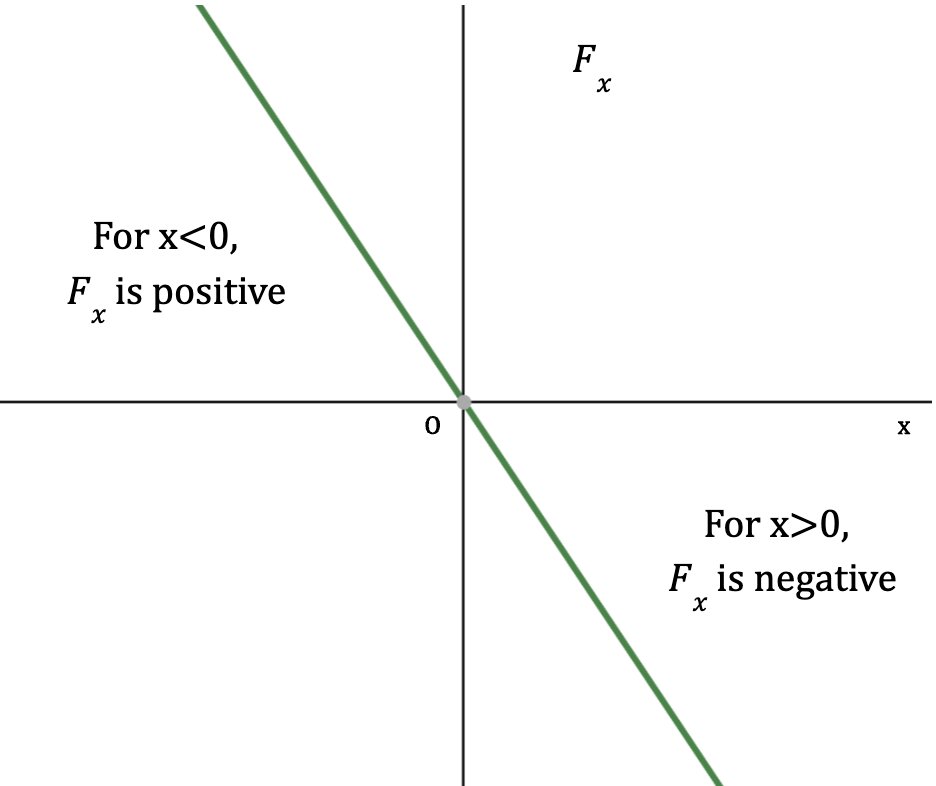
We can now retrieve the force from potential energy functions derived earlier for elastic and gravitational force;
For gravitational force,
 …..(40)
For elastic force,
 …..(41)
Force and Potential Energy in Three Dimensions
Consider a particle moving in 3D plane under the influence of a conservative force, . At any instant, the particle’s location can by described using x, y and z coordinates, and the force can be broken down into it’s three components: Fx, Fy and Fz. Each component of force and the associated potential energy (U) can be a function of x, y and z.
Now break the displacement  into infinitesimal increments of
  with x, y and z components given by
  ,
,  and
and  respectively. Since the components are perpendicular to each other, we can use equation (37) to develop the following relationships;
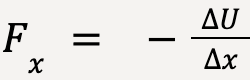 …..(42)
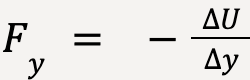 …..(43)
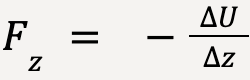 …..(44)
The change in potential energy, when the particle undergoes a displacement is only affected by Fx because Fy and Fz are perpendicular to . We can say the same for change in potential energy along y and z directions.
Now in the limit that , and goes to zero, each component of force (Fx, Fy, Fz) is equal to the partial derivative15 of potential-energy function with respect to x, y and z respectively.
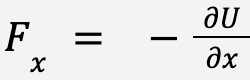 …..(45)
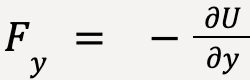 …..(46)
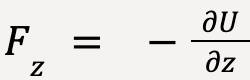 …..(47)
In more compact form, this can be written as;
 …..(48)
Thus, the vector value of conservative force, at any point is equal to the negative gradient ( ) of U.
An Example: When going up a steep edge of a mountain, the gradient of potential energy is large and so is the force that pushes you down the mountain (towards lower gravitational potential energy). When skating on the surface of a frozen lake, the gravitational potential energy is constant and hence, the gradient of U is zero and so is the force.
Energy Diagrams (Young et al., 2020)
For a particle moving in a straight line under the influence of a conservative force, F(x), the graph of it’s corresponding potential-energy function, U(x), can be used to extract details regarding the particle’s motion.
For instance, consider a block of mass m that is sitting on a frictionless surface and is attached to one end of an ideal spring. The other end of the spring is stationary and is attached to a wall. The spring exerts a force on the block given by F=-kx where k is the spring constant.
Now if you apply force to the block and then release it, the block will move back and forth along the x-axis as the spring stretches and compresses. The block will momentarily come to rest when the spring is maximally stretched or compressed at points x=+A and x=-A respectively.
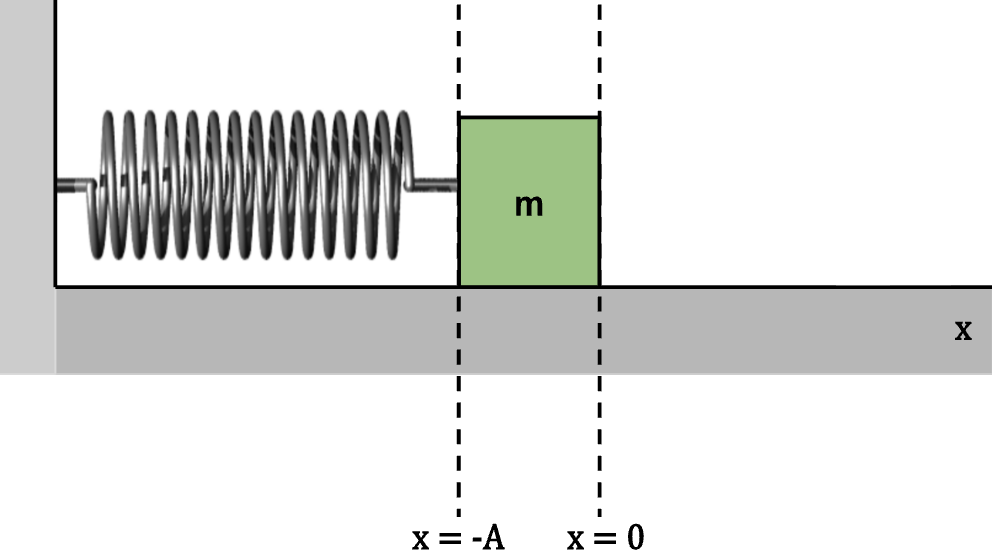
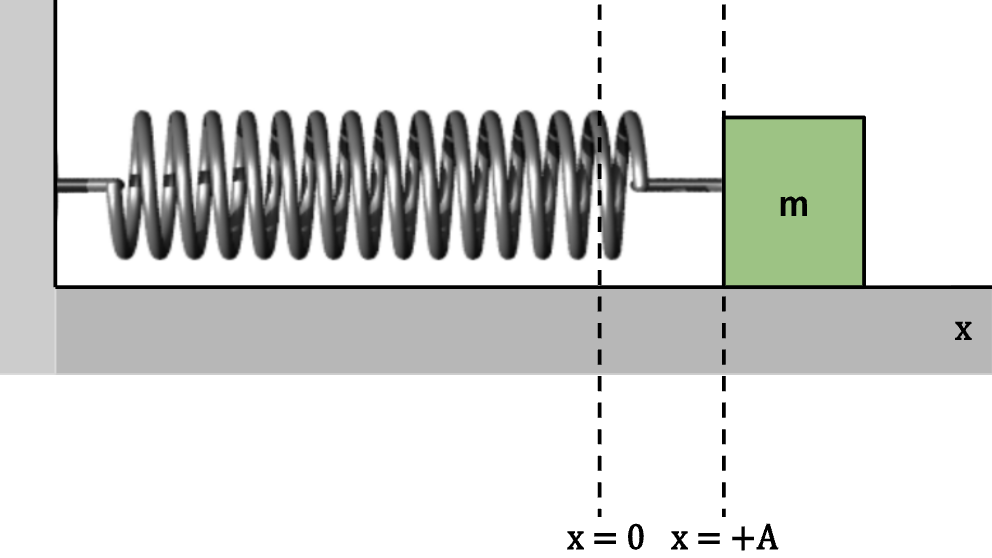
Now, let’s plot an energy diagram16:
Limits of Motion
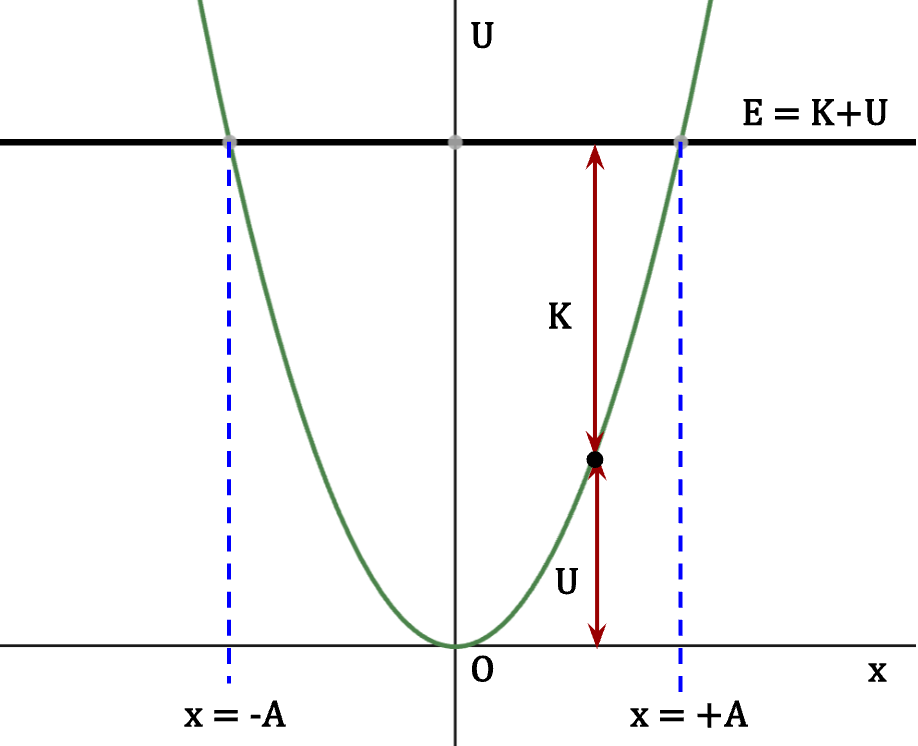
In the energy diagram shown in figure 19, the potential-energy curve is a parabola consistent with the quadratic nature of U(x) associated with the spring force. If elastic force is the only force doing work, then energy is conserved which is why the black line representing the total mechanical energy (E=K+U) is straight and horizontal. In other words, the total mechanical energy, E is constant (independent of x).
At each instant, the difference between the graph of U and E is equal to the kinetic energy of the block,
K = U – E…..(49)
From the graph we can tell that, kinetic energy is maximum at x=0 which corresponds to maximum speed, v, attained by the block. On the other hand, kinetic energy is at it’s minimum (equal to zero) at points x=-A and x=+A. Thus, the block momentarily comes to rest at these points (v=0).
Thus, the limits of motion occur at points where the energy graph intersects the potential energy curve, which happens at points x=-A and x=+A.
The block can never go past these limits established for it’s displacement by the total mechanical energy E. If it were to go past these points, U would be higher than E yielding a negative value for K which is not possible. Therefore, the block will oscillate between points x=-A and x=+A indefinitely17.
Slope
The negative of the slope of potential-energy function, U(x) at any instant is equal to the force, Fx exerted by the spring;
…..(50)
In figure 19;
At x=0, the slope of the curve is zero and so is the force, Fx exerted by the spring. This is referred to as the equilibrium position.
For x>0, slope of the curve is positive which means force is negative (towards the equilibrium position which is the origin).
For x<0, slope of the curve of U(x) is negative which means force is positive (towards the equilibrium position which is the origin).
A force that always aims to bring the particle back to it’s equilibrium position is called a restoring force.
Thus, x=0 is a point of stable equilibrium18.
A Hypothetical Case
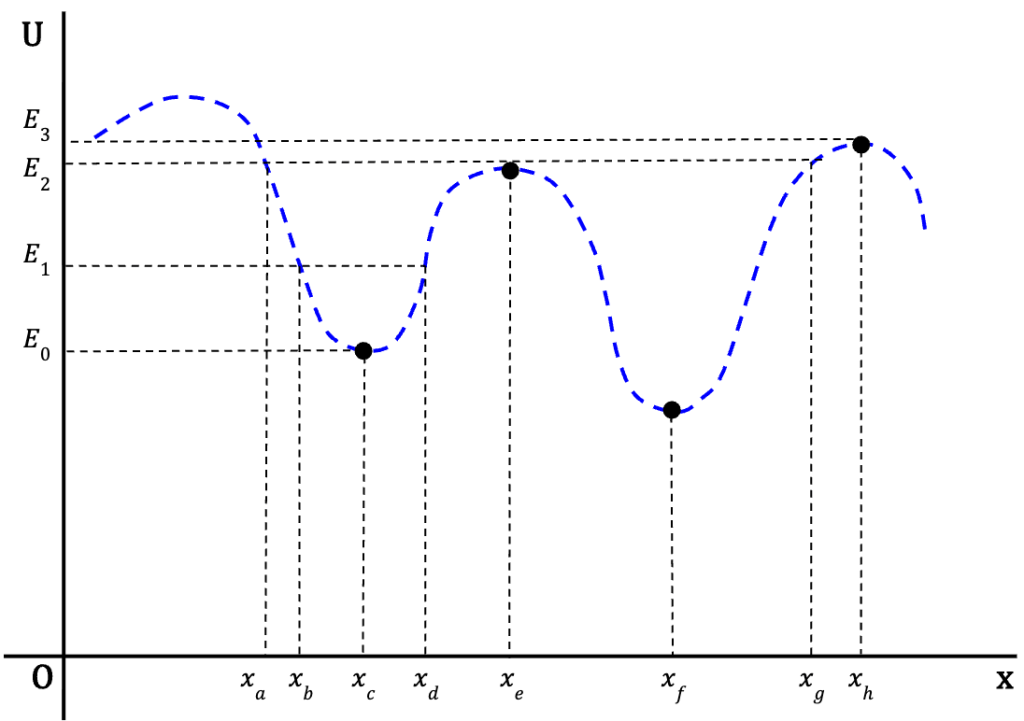
Initially, the particle is at xc with energy E0. Fx at this point is zero. Since the particle is at rest at this point, Eo is the minimum possible energy that the particle can have.
When the energy of the particle is increased to E1, it is trapped between points xb and xd, a region referred to as a potential well. The particle oscillates back and forth between these two points.
When the particle’s energy is further increased to E2, it is trapped between points xa and xg.
With energy more than E3, the particle has the ability to escape to points beyond xh.
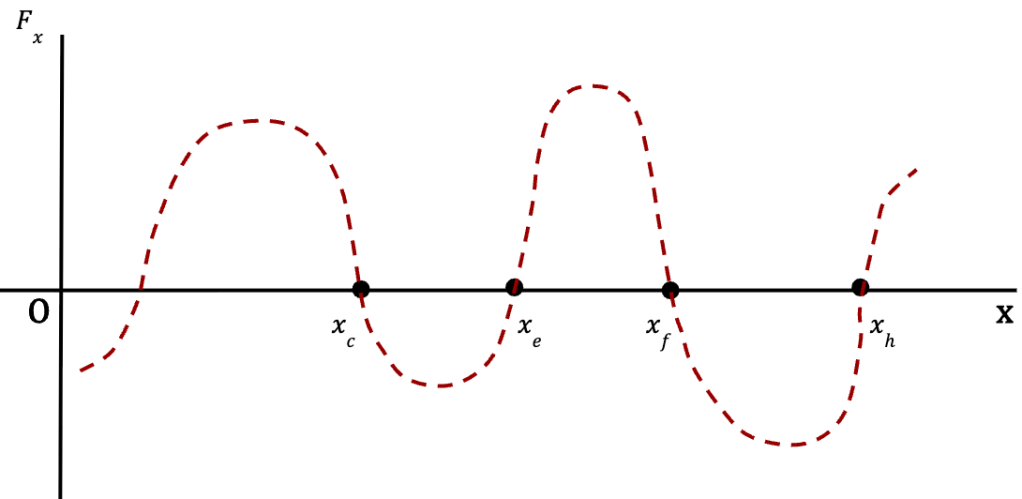
Force is zero at points xc, xe, xf and xh. These are all equilibrium points.
Points xc and xf correspond to the minima on the potential-energy curve. When particle is moved to either side of these points, force pushes them back to xc or xf. This happens because to the left of these points, force is in the positive direction and to the right of these points, force is in the negative direction (see figure 21). Thus, xc and xf are stable equilibrium points.
Points xe and xh correspond to the maxima on the potential energy curve. Even though the force is zero at these points because the slope is zero, xe and xh are referred to as unstable equilibrium points19. When the particle is moved to either side of these points, force pushes them away from the equilibrium point. This happens because to the left of these points, force is in the negative direction and to the right of these points, force is in the positive direction (see figure 21).
Note: It is important to remember that the direction of Fx is determined by the sign of -dU/dx, not by the sign of U(x).
- Young, H.D. et al. (2020) Sears and Zemansky’s university physics: With modern physics. 15th edn. Boston: Pearson. ↩︎
- Assuming the weight is constant. At significantly higher altitudes, weight of an object decreases. ↩︎
- It’s a common mistake to say object’s gravitational potential energy because gravitational potential energy is a shared quantity between the object and the Earth. In other words, gravitational potential energy increases when the object moves away from the Earth or if Earth moves away from the object while the object stays at the same location. ↩︎
- The word system is used because gravitational potential energy is a shared quantity between the object and the Earth. ↩︎
- One can choose y=0 (or as referred to as ground in this case) to be wherever they like. This will change the value of gravitational potential energy (Ugrav) at points y1 and y2 but the change in gravitational potential (
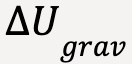 ) will stay the same. Of the two quantities, holds most significance. ↩︎
 - Total mechanical energy is still conserved if an object is acted upon by forces other than gravity as long as they do no work on the object. ↩︎
- The shape of the path is insignificant. ↩︎
- In case of gravitational potential energy, energy is stored in an object that is lifted to a certain height above the ground. However, gravitational potential energy is a shared quantity between the object and the Earth but elastic potential energy is associated with just the deformable object such as a spring. ↩︎
- There are many elastic objects that obey Hooke’s law provided that the displacement x is small. ↩︎
- x>0 if spring is stretched and x<0 if spring is compressed. ↩︎
- A key difference between gravitational potential energy and elastic potential energy is that we are not free to choose x=0 wherever we want, as was the case for gravitational potential energy. In case of elastic potential energy, x=0 is when the spring is neither stretched nor compressed such that elastic potential energy and force (F=kx) that it exerts are zero. ↩︎
- For equation (26) to be true, the spring has to be massless or it’s mass has to be much less than the mass of the object that is attached to it. Otherwise, spring with mass has it’s own kinetic energy. ↩︎
- The system includes the object of mass m, the Earth and the spring with spring constant k. ↩︎
- In reality, air resistance and friction cause a decrease in the total mechanical energy (not conserved) and in order to keep bouncing, the child has to bend his legs every once in a while to add energy to the system which would compensate for any losses. Without air resistance or friction, the child would keep bouncing forever! ↩︎
- Partial derivative with respect to x means that you take a derivative of U by holding y and z constant and allowing only x to vary. This is done because U may be a function of all three components. ↩︎
- An energy diagram is a graph of both potential-energy function U(x) and the energy (E=K+U) of the particle that is under the influence of a force corresponding to this potential-energy function. ↩︎
- In reality, the block comes to rest because of friction. ↩︎
- In general, any minimum on a potential-energy curve is a position of stable equilibrium. ↩︎
- In general, any maxima on a potential-energy curve is a position of unstable equilibrium. ↩︎
 Understand the cosmos